Precision Inspection for High-Volume Automotive Manufacturing
An automotive manufacturer needed a reliable way to verify that every roller was present inside bearing tubes before advancing to downstream assembly. Manual inspection introduced inconsistency and risk.
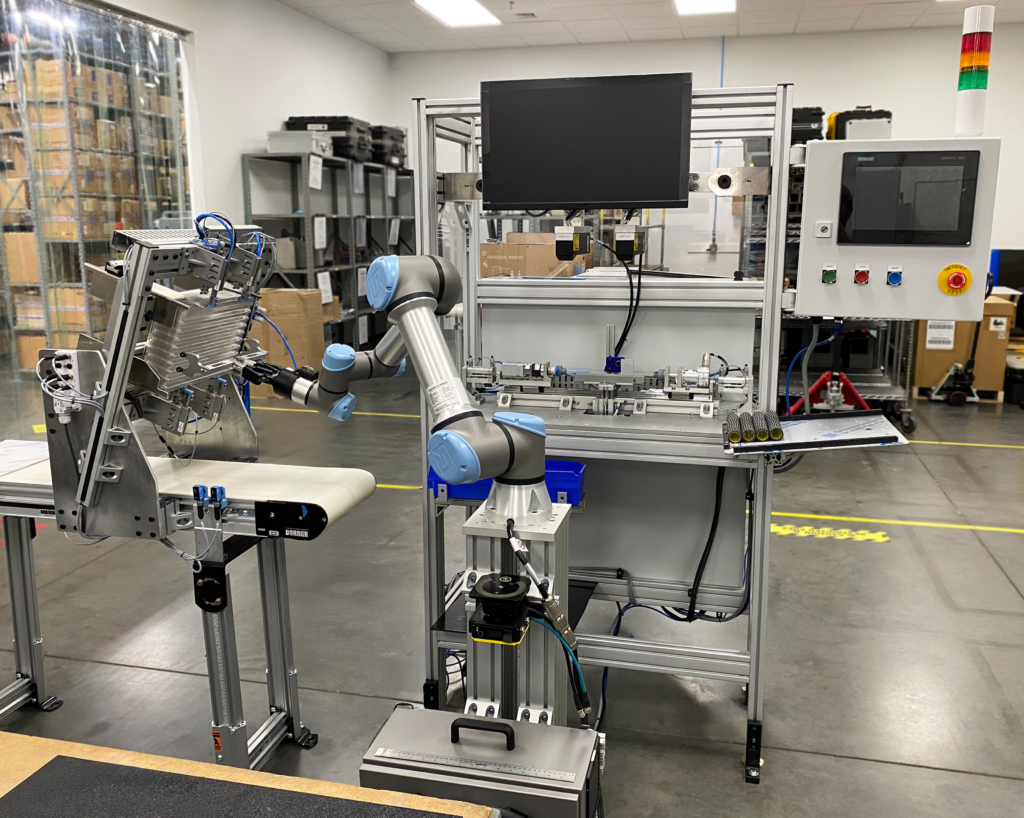
TAG Solutions engineered a fully integrated robotic inspection cell that automates verification using collaborative robotics and 3D vision. The system inspects, makes a quality decision, and sorts parts, all within a repeatable, scalable architecture designed for multiple bearing types.
Technical Highlights
Collaborative robot handling and sorting
Dual 3D vision sensors for roller presence verification
Integrated PLC-controlled system architecture
Intuitive HMI for operators
Automated tray presentation and reject handling
Multi-part capability with streamlined changeover
From Concept to Commissioned System

Challenges Solved Through Automated Inspection & System Integration
For high-volume automotive production, inspection systems must be accurate, coordinated, and easy to maintain. This project required a fully integrated automation approach that could verify bearing completeness while maintaining throughput and simplifying long-term operation.
Eliminated Manual Inspection Risk
Automated 3D verification confirms that every roller is present before the part advances, removing variability and reducing the risk of downstream defects.
Reliable Robotic Part Handling
Collaborative robot architecture ensures consistent pick, inspect, and sort operations with predictable cycle performance across shifts.
Scalable Multi-Part Capability
System structure supports multiple bearing types and streamlined changeovers without major mechanical or programming modifications.
Serviceable, Integrated Controls
Clear PLC architecture and intuitive HMI design simplify troubleshooting, improve visibility, and support long-term maintainability.
Why it Matters
In automotive manufacturing, quality escapes are expensive, not just in scrap, but in reputation, warranty exposure, and downstream disruption.
This project demonstrates what disciplined integration delivers:
Confidence that defects are caught early
Predictable performance across shifts
Flexibility without overcomplication
Automation that works with operators, not against them
For manufacturers balancing throughput and quality, the takeaway is clear: the right automation does not just inspect parts, it protects the entire production process.